

Categories
Real Estate MarketPublished May 19, 2026
Everyone’s Asking the Same Question: Is Another 2008 Coming?

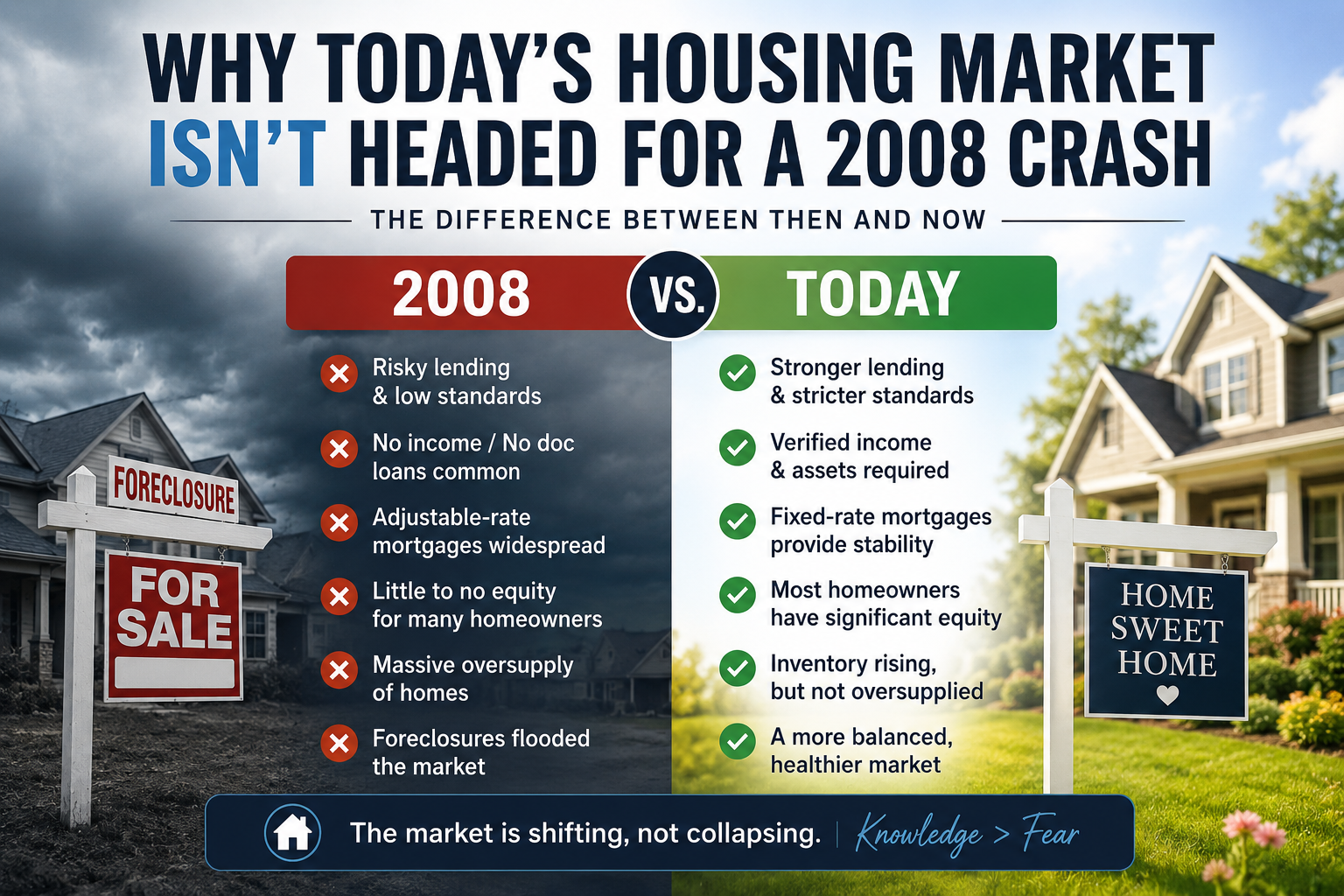
Why Today’s Market Shift Isn’t 2008 All Over Again
If you’ve been watching the headlines lately, it’s easy to feel a little uneasy about the housing market.
Price reductions. Longer days on market. Higher interest rates. Inventory rising.
For a lot of people, it starts to feel familiar… and not in a good way.
The word “crash” gets thrown around quickly anytime the market slows down. But the reality is this:
What we are seeing right now is not 2008. Not even close.
That doesn’t mean the market is perfect. It doesn’t mean every home is going to sell instantly or that prices will keep skyrocketing forever. What it does mean is that the foundation of today’s market is dramatically different from what caused the housing collapse nearly two decades ago.
What Happened in 2008?
The 2008 housing crash was fueled by a combination of risky lending, overleveraged buyers, and an oversupply of homes.
Back then:
- Buyers were getting approved for loans they realistically could not afford
- “No income” and “no documentation” loans were common
- Adjustable-rate mortgages were everywhere
- Many buyers had little to no equity in their homes
- Builders massively overbuilt inventory
When home prices stopped rising, the entire system started to crack. Foreclosures flooded the market. Values plummeted. Lending tightened overnight.
It wasn’t just a slowing market. It was a financial system problem.
What’s Different Today?
Today’s market has challenges, but they are very different challenges.
1. Lending Standards Are Much Stronger
Getting a mortgage today is significantly harder than it was during the early 2000s.
Most buyers today:
- Have verified income
- Have documented assets
- Are fully qualified for the loans they receive
- Are locked into fixed interest rates
Banks learned hard lessons after 2008, and underwriting guidelines changed dramatically because of it.
That matters.
2. Most Homeowners Have Equity
One of the biggest differences between now and 2008 is equity.
Over the last several years, homeowners gained substantial equity as prices appreciated. Even if home values soften in some areas, most owners are still nowhere near being upside down on their mortgage.
In 2008, many homeowners owed more than their homes were worth. Today, most owners still have a strong financial cushion.
3. Inventory Is Rising… But We’re Not Flooded
Inventory has absolutely increased compared to the ultra-competitive frenzy we saw during 2020–2022.
But that doesn’t automatically equal a crash.
In many areas, including here in Hernando County, we are simply moving back toward a more balanced market where:
- Buyers have more choices
- Sellers need realistic pricing
- Negotiation is returning
- Homes take longer to sell
That’s normal.
A healthier market is not the same thing as a collapsing market.
4. Interest Rates Changed the Game
A huge reason the market slowed down is affordability.
When rates jumped from the 2–3% range into the 6–7% range, monthly payments changed dramatically. Buyers became more cautious. Demand cooled. That naturally slowed appreciation.
But slower appreciation is different than a housing collapse.
In many cases, what we are seeing now is the market adjusting to a new normal after one of the most aggressive appreciation periods in history.
So… Should Sellers Be Worried?
Sellers do need to adjust expectations.
The days of putting a home on the market wildly overpriced and still getting multiple offers in 24 hours are mostly behind us in many price ranges.
Today’s market rewards:
- Accurate pricing
- Strong presentation
- Professional marketing
- Patience and strategy
Homes are still selling every single day. The homes that are positioned correctly are still attracting buyers.
What Buyers Should Understand
Ironically, many buyers waiting for a “2008-style crash” may end up disappointed.
Why?
Because if rates eventually come down, buyer competition could heat back up quickly. More buyers entering the market at once can put upward pressure on prices again.
The reality is this:
Trying to perfectly time the housing market almost never works.
The better question is usually:
- Is the payment comfortable?
- Does the move make sense for your life?
- Can you hold the property long term?
The Bottom Line
This market is changing. There’s no point pretending otherwise.
But changing does not automatically mean crashing.
What we are experiencing today looks far more like a market correction and normalization than the financial collapse we saw in 2008.
Real estate has always moved in cycles. The frenzy years were never going to last forever. What we are moving toward is a more balanced, more strategic market.
And honestly? That’s probably healthier for everyone in the long run.

James Adams
CEO & Licensed Agent | The Adams Group Experience | eXp Realty LLC | PLACE
or another way